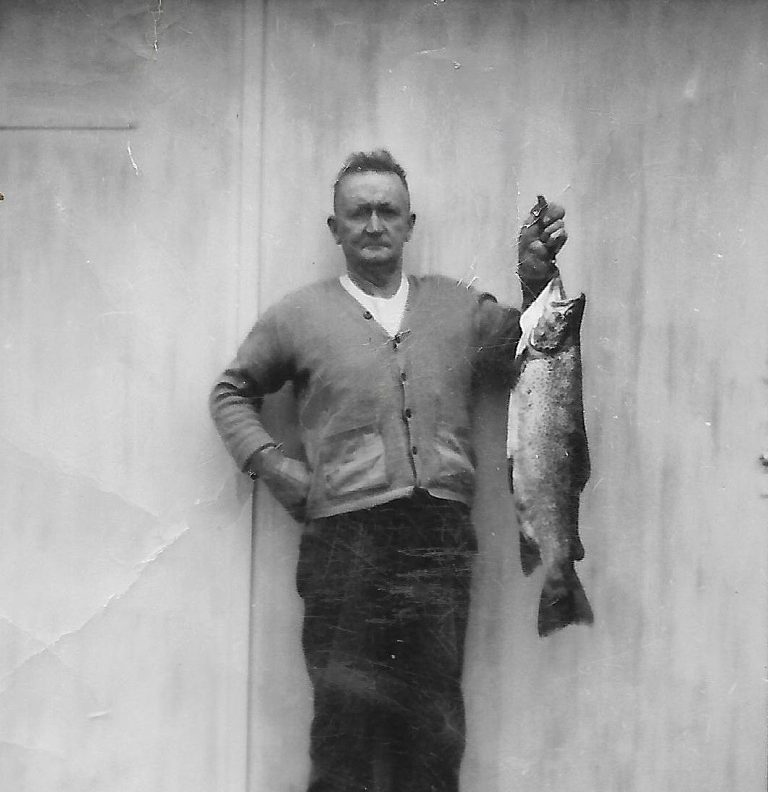
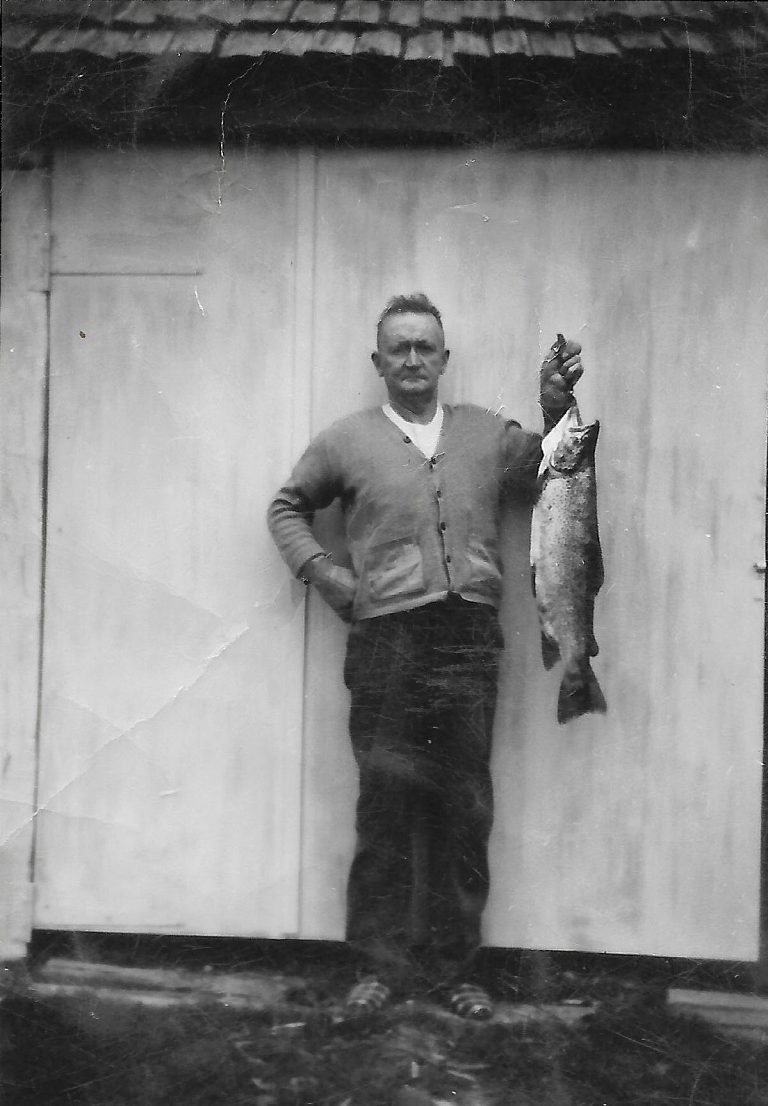
ARTHUR CHARLES “STUMP” JORDAN
Arthur “Stump” Jordan hailed from an area known as The Huntsman – a rural district in the shadow of the Great Western Tiers – near the small town of Meander. Born on the 31st July 1897, he was one of 14 children in the family of Joseph “Joe” and Amelia “Emily” (Ritter) Jordan. He grew up on the family farm and attended the local Meander State School. At school, young Arthur enjoyed the sport of boxing and it was while contesting the school championship title that he earned the name of “Stump”. The story goes, that none of his competitors were successful in knocking him to the ground, and they were heard to comment that he was like “a bloody stump” – impossible to knock over. The nickname stuck and throughout his lifetime he was known as Stump Jordan with many people not able to recall his actual given name.
Stump, like a lot of young rural boys in those days, was introduced to mountain activities such as hunting and fishing, at an early age. From the age of ten, he would climb the tracks behind his home to the plateau. His earliest recollections were of hunting wallabies for food to help with feeding the family, and possums for their skins, to help supplement the household income. The time he spent outdoors and in the bush, instilled in him a deep love of the mountains, so strong that even time spent away from his much-loved Huntsman area could never diminish his connection and passion for the region. As a young man he spent time on the mainland, digging spuds in Victoria, and working in Adelaide. When he returned to Tasmania, he was employed for many years by the Forestry Department after which followed a period as a fettler for the Tasmanian Railways. While living on the north-west coast he got to know the Wynyard area and he captained the Flowerdale Football team.
When World War One broke out Stump felt the call to join the AIF. On 24th July 1916 he enlisted, and like so many young men, he stretched the truth about his age, stating he was 21 years 11 months when in actual fact he was barely 19. His father, having discovered that his under-age son had enlisted, wrote to the Commanding Officer at Claremont Camp advising the circumstances. Consequently, Stump was discharged as being “unable to obtain parents consent”. Undeterred, Stump again enlisted on 26th November 1917 – this time aged 20 years 4 months – however his stint was short-lived when he was declared AWOL and he was once again discharged. Not to be defeated, on 4th October 1918, by now 21 years 2 months and of legal age, he again enlisted and was allotted to B company. However, within a matter of weeks hostilities had ceased, and just 12 weeks after his enlistment Stump received his final discharge on 24th December 1918. His time in the Army was brief but never-the-less at the time of his death, almost 70 years later, he was the last of the World War I veterans in the Deloraine district.
In 1923 Stump married Clarice Ila Nutting, from the prominent and well-known Nutting family of Meander. Ila, as she was more commonly known, and Arthur, had 5 children – 3 sons (Peter, Trevor, & Kevin) and 2 daughters (Mavis & Maisie) whom they raised on their Huntsman farm. Stump spent as much time as he could on his beloved mountain which almost rose from his back door. Hunting became his preferred lifestyle and together with his much-loved dogs he would hunt possums for their skins back in the days when it was still legal to do so. With good quality skins fetching up to “ten bob” each (10/- or $1 in today’s terms), it was welcome income during the lean years of the Great Depression.
At the peak of his fitness Stump could scale the mountain, from his farm to the plateau, in half an hour. He followed tracks up the mountain such as Dixon’s Track and Stagg’s Track as well as forging his own track which to this day is still known as Stump’s Track. At one point in time, he even widened the track making it possible to drive his 4wd vehicle up the mountain. By his own admission, it was an extremely rough ride but nevertheless do-able! And today’s bushwalking fraternity has Stump to thank as he was paid the handsome sum of 200 Pounds ($400) by the State government to forge a track into the Meander Falls.
Stump Jordan is responsible for naming several of the lakes on the plateau which collectively is known as the ‘land of three thousand lakes’. He proudly named Lake Ila after his wife, and Dudley’s Lake was named in honour of his good mate, shepherd Dudley Allison, who, for many years, drove sheep from Bothwell for summer grazing on the Central Plateau.
He also named First-Bar Lake and Second-Bar Lake because of their characteristic sandbars which, during summer or periods of low water levels, make it possible to walk across the lakes via the bars. Today, Stump’s Lake on the Central Plateau is named in honour of Arthur Stump Jordan, an area in which he loved to fish as well as frequent huts such as Allison’s Hut, Tin Hut and Kerrison’s Hut. A little-known fact is that he once established a thriving rose garden at Kerrison’s Hut. Being a hardy and experienced mountain man, well versed in the changeable and usually severe weather conditions of the unpredictable Central Plateau, Stump often relied on a tent or rock overhang for shelter when huts weren’t readily accessible. About 5ft 7ins (174 cms) in height and powerfully built, Stump was bush savvy with a deep understanding of the survival techniques required in the harsh environment of the Great Western Tiers.
When his mountain walking days were over, Stump and Ila moved from The Huntsman into Deloraine where they took up residence in an aged care unit. Arthur Stump Jordan passed away on 7th October 1988 at the age of 91 and just two months later, on 26th December 1988, Ila, his wife of 65 years, also passed away, aged 85. They are buried in the Deloraine Lawn Cemetery.