
Dick Reed was an iconic character of the High Country and virtually became a legend in his own lifetime. Dick was born Henry Dennison Reed, in April 1898. He was the grandson of Henry Reed who migrated from England to Tasmania and who became a successful businessman and wealthy landowner, including the properties of ‘Mountain Villa’ on Wesley Dale at Mole Creek, and ‘Mount Pleasant’ in Launceston.
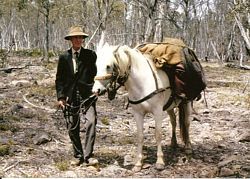
Dick Reed was an iconic
During his adult life, Dick farmed the large sheep and cattle property of ‘Logan’ at Evandale, before moving to another smaller property at Hoggs Lane, Hagley, and eventually retiring to Launceston.
Dick’s love affair with the bush commenced when he was a very young man, in his early twenties. At first he forayed into the south and south west of Tasmania, particularly in areas such as the Vale of Rasselas, primarily looking for grazing lands. Dick built a hut at the Vale Of Rasselas, the first of many which would follow in the Tasmanian highlands.
When Dick turned his attention to the Central Highlands, Lake Naomi became one of his favourite places. He built a hut at the lake, which was unfortunately destroyed by fire in the early 1980s. Dick Reed was a very competent builder and perhaps two of his better known huts are those at Lakes Meston and Junction. He was aged in his seventies when he teamed up with members of the Ranicar and Riley families (the 3R’s), as well as Boy Miles and Alf Walters, to build Meston Hut in 1969, and Junction Hut, which was finished soon after, in early 1970.
Dick was also a skilled horseman and very much at home in the saddle. He usually had two horses with him on his mountain trips, one he rode, the other served as a pack horse, and he would fashion hobbling yards at his huts in which to contain his steeds.
Dick was also known to occasionally use the services of an amphibious plane to get him to his huts. On one such trip, in March 1975, the seaplane crashed on take-off from Lake Naomi. There were four on board and, while Dick was unhurt save for a bloodied nose, the pilot sustained serious injuries which required hospitalisation. Remains of the wrecked aircraft can still be seen in the vicinity of the lake to this day.
In 1988, Dick Reed was invited to become the first Patron of the Mountain Huts Preservation Society. He accepted the position with great pride and, although his association with MHPS was not a long one, he supported and encouraged at every opportunity.
When age and failing health prevented Dick from walking in the mountains, he would still ride, and it was on his horse that, as Patron of MHPS, he made his final trip into Trappers Hut on the way into the Walls of Jerusalem, to assist with plans and impart valuable knowledge for the planned rebuilding of the Hut, which he always knew as Walters Hut. Dick was ever supportive of MHPS and wrote several long and interesting letters to the Society. However, his legacy lives on in the form of the mountain huts he built and the walking tracks he forged, which are still utilised by bushwalkers and fishermen to this day.

Richard ‘Dick’ Miles, the son of Nicholas and Effie Miles, was born in Mole Creek in 1921, and later lived in Liena. Born into the Miles/Walters families – names that are synonymous with places such as Dublin Plains and Walters Marsh – he had mountain cattlemen blood coursing through his veins. Dick lived his life in the saddle. He was only 4 years of age when he first learned to ride and he was still riding right up to the time of his death, seven decades later.
Dick shunned school and much preferred to be working the land, droving cattle, or trapping in the bush. He was barely a teenager when he swapped school work for farm work—ploughing, scrubbing the land and snaring. Like so many who lived through the Great Depression, Dick found snaring a way of survival for his family and became very proficient at it.
There was not much Dick could not turn his hand to and he established a reputation as a skilled bushman, stockman, bullock driver and an accomplished mountain cattleman. Every summer for decades, Dick drove cattle to the highlands above the Mersey River and he leased land at the Borradaile and Dublin Plains. Together with his younger brother, Ray (‘Boy’), Dick was also competent in the art of building mountain huts.
Trappers Hut, in the Walls of Jerusalem area, is an example of one such hut that Dick helped to build. It was in 1946 and it took four men four days to complete. Dick was a young man in his mid-twenties when he, his brother Boy, and two Walters brothers, built the hut which would serve them well during their hunting trips. Many, many years later, the MHPS rebuilt the Trappers Hut, which was in a serious state of decay, and in December 1990 Dick Miles attended the official opening ceremony of the restoration of the hut. Then aged 70, and due to enter hospital the very next day for open heart surgery, Dick rode on horse-back so that he could witness the re-birth of the hut which he had helped build all those years earlier.
Dick’s skill on a horse was second to none and there was no greater testament to his talent on horseback than in 1988 when he won the ‘Tasmanian Mountain Cattlemen’s Championship’ at his beloved Borriedale Plains. Dick was aged 68 and not only beat much younger competitors in the field, but also out-smarted a rider by the name of Ken Connley. Ken hailed from the Bogong region of Victoria and was not only a master amongst the Victorian High Country Cattlemen but he was also a stunt double and crack rider in the 1982 film ‘The Man from Snowy River’. It was a proud and memorable time for Dick and established him as King of the Tasmanian High Country.
Dick was in his 73rd year when he passed away on May 7th, 1993 and was, by then, a well known and legendary character of the Mersey Valley and High Country.
He was the second Patron of the Mountain Huts Preservation Society, from 1990 until his passing in 1993.
Acknowledgment: Dick Miles photo courtesy of The Examiner newspaper

Charles William Victory Crowden, or ‘Charlie’ as he was popularly known, was born and raised in the Deloraine district and, apart from a stint in the Army, lived almost his entire life in the Meander Valley, which probably accounts for the deep love and understanding he had of the local area. As a young teenage lad growing up in the Depression years, he milked cows and caught rabbits to make ends meet. Born on 11th November 1918, the day World War I ended, Charles went on to serve in World War II. He initially enlisted in the CMF in March 1939 and, in July 1942, he transferred to the AIF. As a Lieutenant in the Australian Army, he spent a total of 7 years in the infantry, which included service in New Guinea, and, later, he served with the Occupying Force in Japan after the war.
Following his discharge from the Army in June 1947, Charles commenced a career as a Dairy Officer with the Department of Agriculture on King Island and after two years returned home to Deloraine where he continued to work with the Ag. Dept. until his retirement.
Charles had a strong affinity with the land and the surrounding mountains and his passion was in bushwalking and the great outdoors. He was ever willing to take interested people into the mountains and it was while guiding a group into Meander Falls, he had a chance meeting with an Examiner newspaper reporter, who made the suggestion to Charles that he should think about starting a Walking Club. The reporter, Geoff Wilson, offered to run an advertisement in the paper and it subsequently received an overwhelming response. The first walk was in October 1972 when 50 people turned up to walk into Liffey Falls—and the rest, as they say, is history.
The Deloraine Walking Club came into being in 1972 under the leadership of Charles Crowden, who held the position of President for the next 19 years. In 1982 he was inducted as the first Life Member of the Club. Undoubtedly, his greatest accomplishment within the Club was the restoration of Haberles Hut on Parsons Track in the Great Western Tiers, above Caveside.
Following the formation of the Mountain Huts Preservation Society in 1988, Charles held the position of Vice President for 7 years. In 1992, together with the then Treasurer of MHPS, Kelvin Howe, Charles played a vital role in addressing the World Heritage Area Consultative Committee in Strahan putting forward the strong recommendation that the Society be granted permission to rebuild the Lake Nameless Hut on the Central Plateau —an idea which had been blocked and thwarted by government bureaucracy for many years. The bid was ultimately successful and the MHPS has grown in strength from that day on.
In January 1991, Charles was named Deloraine Citizen of the Year in the Meander Valley Australia Day Awards and in November of the same year he was given the prestigious honour of being named a Paul Harris Fellow by Rotary. The following year, in June 1992, he was awarded the Medal of the Order of Australia (OAM) in the Queen’s Honours List, for services to the community, particularly through the RSL, the Anglican Church and the Deloraine Walking Club.
Is it any wonder that the MHPS found in Charles the necessary qualities to invite him to take the role of Patron of the Society? Charles accepted the position in 1993 and from 2000 shared the role with long time friend and acquaintance, Carlyle Sherriff.
It was with a deep sense of loss that members of MHPS learned of Charles’ passing in his 99th year on 14th July 2017. He had been the Society’s esteemed Patron for 24 years, as well as past Vice President and Life Member. Charles’ hut building skills and bush knowledge were second to none and it was a wisdom he shared unselfishly in a mentoring role with all who sought his advice. It was an honour to have had his support and valuable contribution within the Society for three decades.

Carlyle (Carl) Sherriff became the fourth patron of MHPS in 2000.
He was born in Deloraine in 1934 and apart from an absence during his teenage years to early adulthood, he lived his life – until retirement – in the Deloraine district, against the backdrop of the Great Western Tiers. This no doubt contributed to his keen interest in bushwalking and an intense awareness of the surrounding mountain environment. However, it is not at all surprising that Carlyle hade a deep love of the high country and mountain huts, given that he was also a grandson of George Lee, the original owner of The Paddocks.
Upon retirement, Carlyle moved to Launceston but prior to this he was known to many and very well respected in the Deloraine area where, for 36 years, he was a law clerk in the firm of a local solicitor. Carlyle was also a lay reader at St Mark’s Anglican Church for almost 40 years. He was a founding member of the Deloraine Walking Club when it was formed in 1972 and, along with his passion for bushwalking, was also a member of the Deloraine Dramatic Society and over the years performed roles in many of their annual productions.
In June 2005, Carlyle was awarded an Order of Australia Medal (OAM) in the Queen’s Birthday Honours List for his service to the community of Deloraine and the Anglican Church.
Carlyle was an original member of the Mountain Huts Preservation Society when it came into being in 1988. At the first meeting of MHPS he was elected Secretary, a position he held for 10 years. They were difficult years, when a fledgling MHPS was trying to establish itself as a bona fide entity in the crusade to retain, maintain and rebuild mountain huts, but was being constantly met with negativity, bureaucratic red tape and obstacles in the way of progress. Carlyle, with his clerical skills and intense commitment to the cause, was immensely beneficial and influential in helping the Society achieve some of its very early goals. He devoted much time and thought in his role as Secretary in the formative years of the MHPS, to the writing of letters and the preparation of applications and detailed submissions to government departments and various other groups and organisations, which ultimately led to successful projects and the credibility and good standing that the Society has today across all levels of the community.
Carlyle also took an active role in working bees for the restoration and rebuilding of early MHPS projects, namely Trappers Hut in the Walls of Jerusalem area and Ironstone Hut at Lake Nameless and was present at most of the official openings of completed MHPS projects, often taking part in the formalities of the occasion.
Carlyle’s achievements were driven by his intense belief in the value of the iconic symbols of the Tasmanian high country, in particular the mountain huts, and his contribution during the formative years went a long way in cementing the reputation of the MHPS in the community and within governmental departments as an eminent force to be reckoned with.
In 2000, Carl accepted the role of co-patron which he shared with good friend Charles Crowden – a role he enjoyed for 25 years. Life membership was bestowed upon him in 2013.
Members were greatly saddened to learn of Carl’s passing on 1st June, 2025 – aged 90.
He was truly one of life’s gentlemen.
 Margaret Anne Thwaites – known to all as “Anne” – was born on 25th September 1937 in Hobart, Tasmania, the eldest child of Jack Thwaites and Cecilie Cripps. Two years later the birth of her brother, Bill, completed the family.
Anne’s early education began at the Sandy Bay and Princes Street Primary Schools with secondary education undertaken at The Friends’ School in North Hobart after which she entered the University of Tasmania and ultimately graduated with a Bachelor of Education. As a physical education teacher, she had various placements around the State including on the N.W. Coast at Ulverstone High School, and in southern Tas. at New Norfolk High with a 12-year posting at Clarence High School. Itinerant primary school teaching followed and included “Learn to Swim” classes at the Hobart, Clarence & Glenorchy swimming pools. Retirement from teaching followed in the late 1980’s.
Throughout her teenage and early adult years, Anne enjoyed the pleasure of horse riding, and the freedom it gave while also bestowing a sense of responsibility for the animals in her care. She fondly recalls a fun time spent in Wales (U.K.) preparing, caring and riding the Welsh ponies. As a descendant of the pioneer bread baking Cripps family, Anne developed a love of the horses used to pull the carts for bread deliveries in the suburbs of Hobart. While at Princes Street Primary School, at the end of each week, she would walk to Sandy Bay Road to meet her grandfather, George Cripps, as he delivered extra supplies of bread for the weekend. When the horse-drawn carts were eventually phased out during the late 1950’s and replaced by motor vehicles, the horses were retired and agisted at “Lennonville” on Bruny Island. Anne’s favourite horse was “Dolly” and she remembers good times riding at Bruny Island.
Anne commenced bushwalking from an early age and, living near the water – the beautiful Derwent River – it was not surprising that she found a love of water sports including surfing, kayaking, sailing and with snow-ski-ing also thrown in to the mix. Her brother Bill was a renowned surfer and in 1965 held the title of Tasmanian State Surfing Champion. In 1971Bill founded his own surf wear company named Seaworld which today is known as Red Herring Surf.
In her upper years of primary school, Anne joined the Sandy Bay Swimming Club which originally operated from the Seaside Tidal Sandy Bay Baths and later, Amateur House in Collins Street. She took part in Royal Lifesaving as well as Water Ballet (known today as synchronised swimming) which was performed at various southern regattas.
Anne went on to teach children at “Learn to Swim” classes at the old Wrest Point Pool which was hired by football legend, Harold “Nunky” Ayers. Nunky was an active member of the Hobart sporting scene, not only recognised for his football skills but he also held as many as 24 state swimming titles. Anne recalls it was an exciting time as the cabaret stars working and staying at Wrest Point would often come down for a chat. One such entertainer was Neil Diamond.
Anne also took up hockey during Primary School, continued playing in teams at The Friends School, and carried it into her adult life, but by then was coaching as well. Until just a few years ago, she regularly played tennis, and having commenced yoga more than 60 years ago, Anne still belongs to a group she joined 25 years back.
Is it any wonder she grew up with a love of the outdoors and a keen sense of the need to preserve history and promote conservation for future generations. This prompted her to join several organisations in her endeavours to make the world a better place. Some of the groups included numerous sports clubs, along with The Eastern Shore Ramblers (bushwalking), the Tasmanian Historical Research Association (T.H.R.A.), the Australian Garden History Society (A.G.H.S.), the Bothwell Historical Society (B.H.S.) and of course the Mountain Huts Preservation Society (M.H.P.S.). Anne, along with her partner of over 50 years – Ken Wright, were granted Life Membership of the Tasmanian Land Conservancy (T.L.C.) having joined the organisation from its very beginning. Sadly, Ken passed away in early 2026 – however, Anne remains a helpful participant to this day.
It could be said that Anne was born with bushwalking coursing through her veins. Just the year before she was born, her mother, Cecilie, and her mother’s friend and bridesmaid, Rhona Warren (after whom Lake Rhona in Southwest Tas. is named) walked to Frenchmans Cap in 1936 with Jack Thwaites, Leo Luckman and Jock Turner.
Anne’s father, Jack, was a well-known Tasmanian pioneer bushwalker and respected conservationist, having emigrated from England with his family when he was 11 years old. Jack, along with E. T. Emmett, Director of the Government Tourist Bureau at that time, went on to establish the Hobart Walking Club in 1929, and was responsible for naming many landmarks in Tasmania’s National Parks. He also served on numerous National Parks Boards, to name but a few of his abundant accomplishments. Jack Thwaites also had a long connection with Madge Wilson at The Steppes Reserve in the Central Highlands. In the early 2000’s, Anne followed in her father’s footsteps – and along with partner Ken – dedicated enormous time and effort to the maintenance and care of the historic buildings at The Steppes, visiting every ten days for many years, promoting awareness and giving guided tours. To this day Anne’s love of, and passion for, The Steppes continues unabated.
Together, Anne & Ken bushwalked extensively across Bruny Island, Maria Island, and areas on the East Coast, North East and the Tasman region. They often led walks for groups of people and Anne & Ken first joined MHPS after they extended an invitation to Secretary Ian Hayes and the then President Roger Nutting to address a bushwalking group in the Chudleigh Hall many, many years ago.
When selecting a Patron, MHPS sought someone with a genuine connection and commitment to the Society’s values and principles, and it was an exciting time when it was announced that Anne had accepted the invitation to take up the role of Society Patron, commencing October 2025.