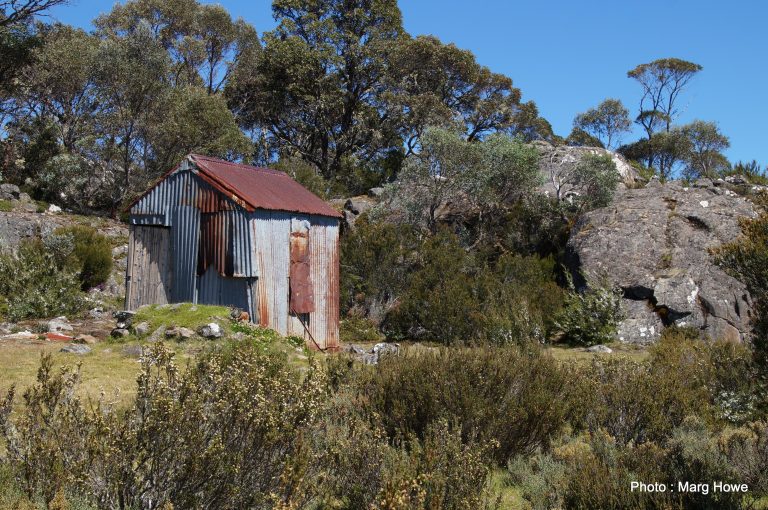
Tin Hut Central Plateau
Tin Hut is a single roomed hut believed to have been built in the early 1900s when it was originally known as Roddas Hut. But the origin of the name ‘Rodda’ is somewhat of a mystery.
What is known is that in 1927, William Nutting, a bushman from Meander, went missing on the Central Plateau and a large-scale search for him ensued. Although Nutting’s body was eventually found in the Walls of Jerusalem area, the search had covered a much larger area and extended as far east as Lake Augusta. A man by the name of L.G. (Llewellyn George) Irby, the then Conservator of Forests within the Forestry Department, led the search and it is through his diaries and photographs that the name Rodda first appears. Nutting was known to have a crude hut at Clifton Flats, and this was duly checked after it had been determined that there was no sign of the missing man at Allisons Hut. Between these two points of interest was another hut – Roddas Hut- which according to Irby’s search diaries also showed, upon inspection, no sign that anyone had been there recently.
The accompanying b&w photo was taken by L. G. Irby at the time of the search in 1927. The photo and information from Irby’s diaries were kindly provided by his granddaughter Judith M. Flint.
Research indicates there was a “Roddas Run” in the area, estimated to be roughly 5,500 acres in size and it is feasible to assume that the hut may have been built to accommodate pastoral workers. Possibly the name change could have occurred when the lease on Roddas Run ended and fishermen frequented the area. It is unclear when this name change happened, but all future references bore the name of Tin Hut. By the late 1900s it had seen better times and was little more than a corrugated iron shell attached to a timber frame on a stone foundation. The roof was intact, but the original single window was missing and the hole covered over with a sheet of tin, while the chimney had long ago collapsed. A pile of stones indicated where the fireplace and chimney were once located.
Mountain Huts Preservation Society (MHPS) was keen to adopt Tin Hut as a worthy restoration project. After an initial visit to determine a work plan, it was deemed necessary to install some bracing for short term stabilization due to the precarious nature of the hut which was at real risk of falling over. Once approval of the plan was granted, Tasmania Parks & Wildlife Service assisted with the transport of materials, tools and concrete to the site via a helicopter lift. This was of great assistance and saved many volunteer hours.
In the latter part of 2024, over the course of 4 well attended working bees, MHPS volunteers completed significant repairs and maintenance. A new front wall was framed up and with bottom plates replaced and studs repaired, the hut was now level and stable. The floor section was lifted to enable the installation of concrete and hold down bars. The repaired floor was re-installed along with a new replica window and the cladding was given a coat of protective oil. The door and roof both received repairs and stones were laid at the hearth and doorway areas. Once the interior lining was completed, a seat and benches were also built. With the restoration complete, all that was necessary was to tidy up and carry out the gear.
MHPS acknowledges and appreciates donations from Lyndon Jago for the window and Ian Hayes for timber used in the seat and bench.
A sign was placed inside the hut featuring L. G. Irby’s 1927 photo of the Nutting search party at Roddas Hut.
The mystery of who originally built Tin/Roddas Hut, and when, was further deepened during the restoration process when it was discovered that the Hut’s timber frame appeared to have been prefabricated off-site. The details of the joinery on the framework showed that it had been constructed in a workshop with smaller sized timbers and was extremely well built. The stencilled brand of “Kemp & Denning” was also discovered in a few places including on the door. Kemp & Denning Ltd was founded in Hobart in 1902 and sold timber, building materials and hardware. Therefore, it is assumed that the Hut’s framework was crafted offsite and transported to its current position for final assembly.
Tin Hut is in the area known as Nineteen Lagoons – a series of shallow lakes accessed via the Lake Augusta Road on the Central Plateau. From the doorway at the Hut’s eastern entrance, Lakes Ada and Augusta can be seen in the distance. The Lake by the same name – Tin Hut Lake – is out of view to the west and behind the hill which shelters the Hut. It is popular amongst fishermen for its prized brown trout.
In late December/early January the area hosts a magnificent display of Richea Scoparia which bears flowers in shades of red, pink, gold, cream and white. The prickly shrub is endemic to the State and is found in the alpine and subalpine areas of Tasmania.
Tin Hut is for day use and emergency shelter only. There is no toilet, no fire and no reliable nearby water.