Basil Steers Hut #1
Basil Steers was responsible for building several huts on the February Plains to meet his need for shelter and somewhere to dry and cure the skins of wallaby and possum captured during the snaring seasons.
Basil Steers No 1 Hut was built on the western edge of the northern end of the February Plains. These Plains sit at over 1100 metres above sea level which makes them amongst the highest plateau country in Tasmania, and subject to incredibly harsh and hazardous weather conditions. These days the February Plain is located within the Cradle Mountain-Lake St. Clair National Park.
The exact date the Hut was built is not certain, however, Basil’s son, Philip, recalls that he and his brother Wayne helped their father build the hut when Philip was just a young lad about 10 or 12 years of age. This effectively dates the Hut somewhere between 1972-74. Basil’s employer at the time, Ken Jacobs, also helped build the hut and materials were carted to the hut site by Ken’s 4WD vehicle along an old stock route. The Hut was built in a single weekend. It was used for the grazing of cattle in the summer months, and during the winter months Basil used it for his snaring.
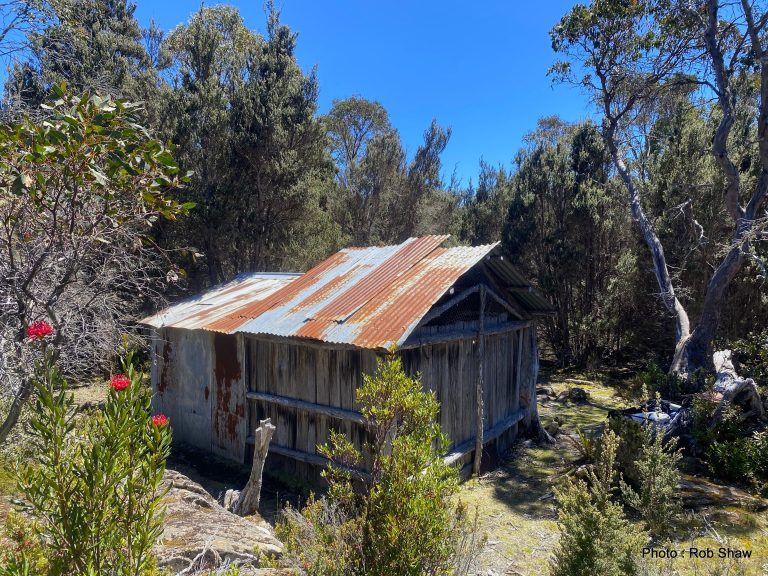
The singled roomed hut was relatively small. It was built from split eucalyptus slabs and tin, featuring the typical external framing techniques employed by the early hunters, which enabled internal slab walls to be kept free, maximising room to nail the stretched skins for drying. The hut’s framework consisted of four corner posts, one of which was a tree stump. Top and lower wall plates were notched and nailed into position; this provided the basis for the remaining frame work to be attached. The Hut had a raised open-ended gable roof at the eastern end, (to allow the smoke to escape) with a small skillion porch attached to the northern side of the hut. There was a single door, no window, and an earth floor where-upon a fire was set centrally for the purpose of providing heat and smoke to aid the drying process of the skins. Flagstones surrounded the fire place and also were extended to cover the damp ground at the huts entrance The living quarters were basic but served the needs – a bunk and small bench with a couple of shelves, with a rough sawn timber floor. Just outside the hut was the obligatory dog kennel consisting of rocks and tin piled over a fallen log.
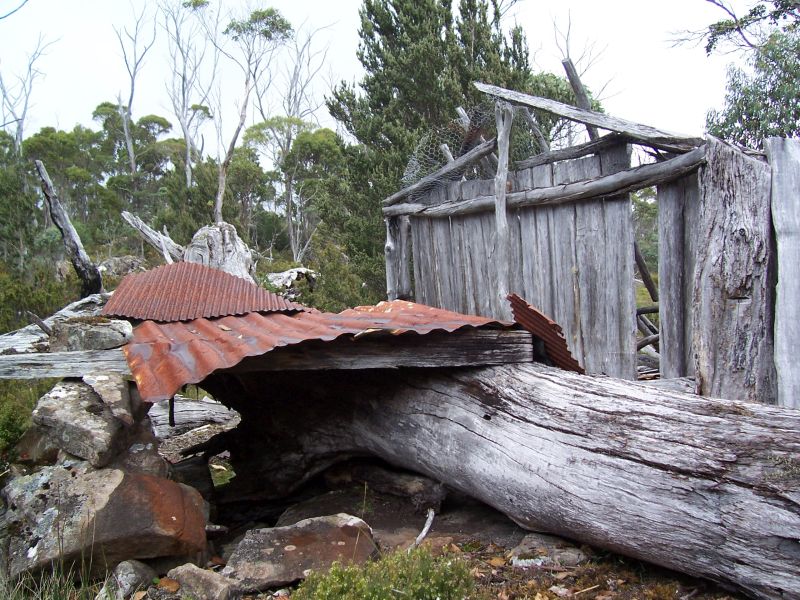
Sometime during the mid 1970’s, this Hut was damaged by fire, and over ensuing years, the weather caused gradual and continued deterioration until the Hut had fallen in on itself, with only a couple of part walls still standing amongst the debris of timber and tin.
In December 2006, the derelict Hut came to the attention of several MHPS members who were participating in a working bee at Basil Steers Hut No 2 site, situated just a couple of kilometres from the No 1 Hut. In February 2007, a field trip involving 21 people comprising MHPS members and PWS staff visited the decaying remains of Basil’s Hut No. 1. The site received a further inspection from MHPS and PWS representatives via a helicopter trip in August of the same year.
In June 2008, MHPS submitted a detailed proposal for the restoration of this unique snaring hut on February Plains and the first official working bee took place in January 2009 when the site was cleared of burnt debris and generally tidied up and prepared for future work. Discarded roofing iron from the #2 Hut (which ironically had initially been taken from the #1 Hut after it was damaged by fire) was returned via an air lift by PWS in May 2009.
PWS assisted with airlifts of materials required and, following a total of 13 working bees, over a 20 month period, which registered more than 550 voluntary hours from MHPS members, Basil Steers Hut #1 was fully rebuilt and restored to its original design, using much of the original materials on site, and was completed by September 2010.
Today, four decades on, the Hut is well hidden amongst a thick mass of tea-tree scrub which gives a closed in and secluded atmosphere. This setting is somewhat different to the one Basil would have been familiar with when he built the hut in an open area where the growth of grassland was promoted by the grazing of cattle and the light burning of vegetation.
The Mountain Huts Preservation Society, under a partnership agreement and in co-operation with the Parks & Wildlife Service, is proud to have been responsible for the rebuilding of Basil Steers No 1 Hut on February Plains and hopes the Hut will stand as a testament to by-gone traditions and as a monument to a master of the bush and the last of our high country snarers.
Official Opening of Basil Steers #1 Hut
On Saturday, 26th March 2011, under a perfect blue sky, more than 130 interested people walked into Basil Steers #1 Hut to witness the official opening of the fully rebuilt hut. President Roger Nutting welcomed everybody and gave a brief summary of what had been involved in the rebuilding project. Special guests were three of Basil’s four children, Philip Steers, Anne Crowden and Christine Donohue, who all participated in the opening ceremony. Philip spoke of his father’s exploits in the bush, and of Basil’s skill as a bushman and of his hut building exploits. Anne spoke fondly of Basil, the family man, and the fun times she remembered spending in the mountains, and of birthday parties in the huts. Christine performed the ribbon-cutting ceremony to officially signify the opening of the hut. Several PWS members were also in attendance and Chris Colley (Northern Regional Manager) and Chris Emms (Parks & Reserves Manager for GWT) acknowledged and praised the work of the MHPS and the success of the partnership agreement with MHPS. Ken Jacobs, a past employer and friend of Basil, was also present to witness the re-birth of the Hut, which he had helped Basil build.
This event was the culmination of many, many months of hard work, and it is very satisfying to now have the hut restored as a tribute and a memorial to such an iconic figure of the high country—Basil Steers.